Solar Energy, Part II: the problem isn’t the material, it’s the interface.
Perovskites rarely fail in the bulk. They fail where layers meet, and that is precisely where atomic layer deposition operates.
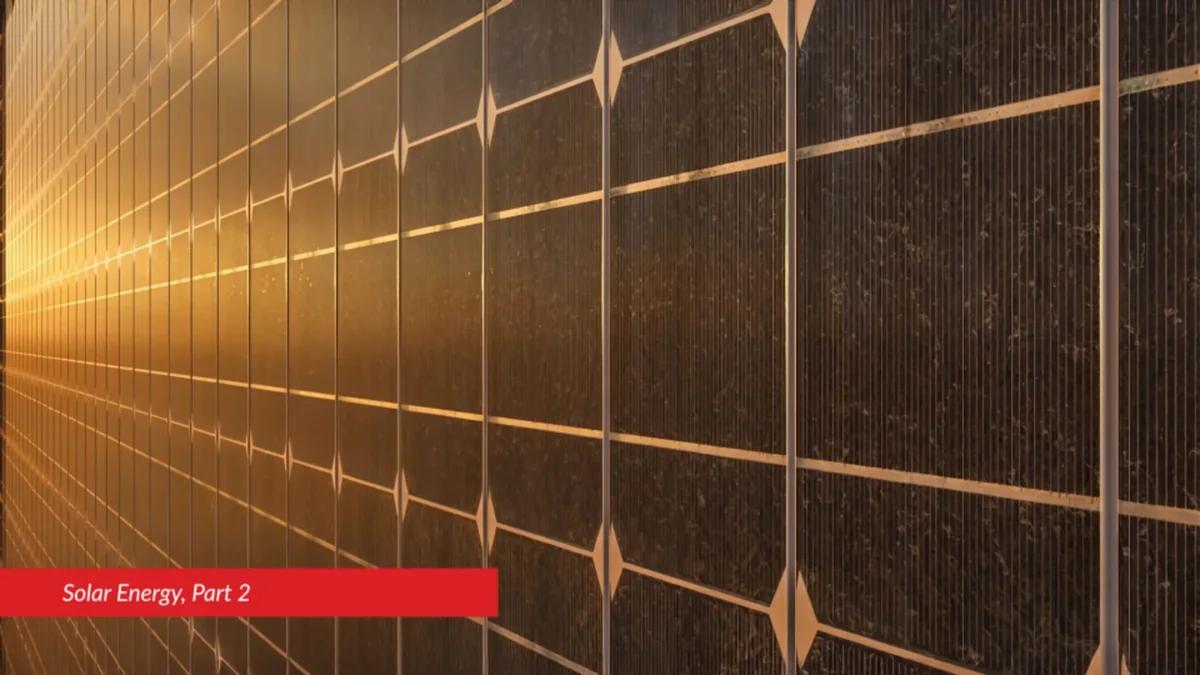
The failure point in next-generation solar isn’t the bulk material — it’s the interface.
In perovskite devices, performance is governed at the nanometer scale where layers meet, where defects accumulate, and where environmental exposure begins to break the system down. These are interface-driven systems, where charge transport, recombination, and long-term stability depend on what happens across boundaries between materials. When those interfaces are poorly controlled, the device fails quickly. When they are engineered effectively, the behavior of the entire system is more stable. We are still in Act II of the Great Solar Energy Saga.
It’s not that perovskites fall short because the concept is flawed. They fall short because stability has not yet been engineered into the system at scale. Surface engineering is what could close that gap.
Atomic Layer Deposition (ALD) operates precisely at that boundary. It enables conformal, angstrom-level films that stabilize reactive surfaces, controls transitions between materials, and reduces defect-driven failure modes. In perovskite architectures, this is what allows the system to function outside the lab.
In Solar Energy’s journey, a wise Sage offers ALD to our hero to achieve their mission. Introduced at the greatest time of need, the Sage puts the hero on a path toward glory. It’s ALD, says the Sage.
Act II is not about proving that perovskites can work. We already know that. It is about proving that they can be trusted to produce consistently, operate reliably, and scale without introducing new failure modes that would put energy systems at risk.
I believe perovskites with help from ALD are paving the way for the promise of the grand third act. That transition from possibility to reliability may be slower and less visible than breakthrough science. It may require iteration, process discipline, and a deep understanding of how materials behave over time and under stress. But that’s what Act III will be about. The final promise of what we hoped for.
Perovskites are not the final form of solar, but they represent that critical acceleration that launches the finale. They expand what is possible and reset expectations for efficiency and cost, while forcing the industry to confront its most difficult challenge: how do we turn something fragile into something dependable? From stage left, the Sage quietly whispers… ALD.
About this piece.
Michael Trotter is Chief Executive Officer of Arradiance, LLC.
This is the second of two parts. Part I sets out where solar actually stands. For the published research behind these interfaces, browse the solar cell studies in the research library, or see how GEMStar and PRIME run the thermal ALD, PE-ALD, and MLD processes involved, or have a film stack deposited through our ALD coating service.