
Solar Energy, Part I: progress isn’t the same as completion.
Silicon photovoltaics are mature, bankable, and approaching a ceiling. Perovskites make the next phase believable, but they are not yet ready to carry it.
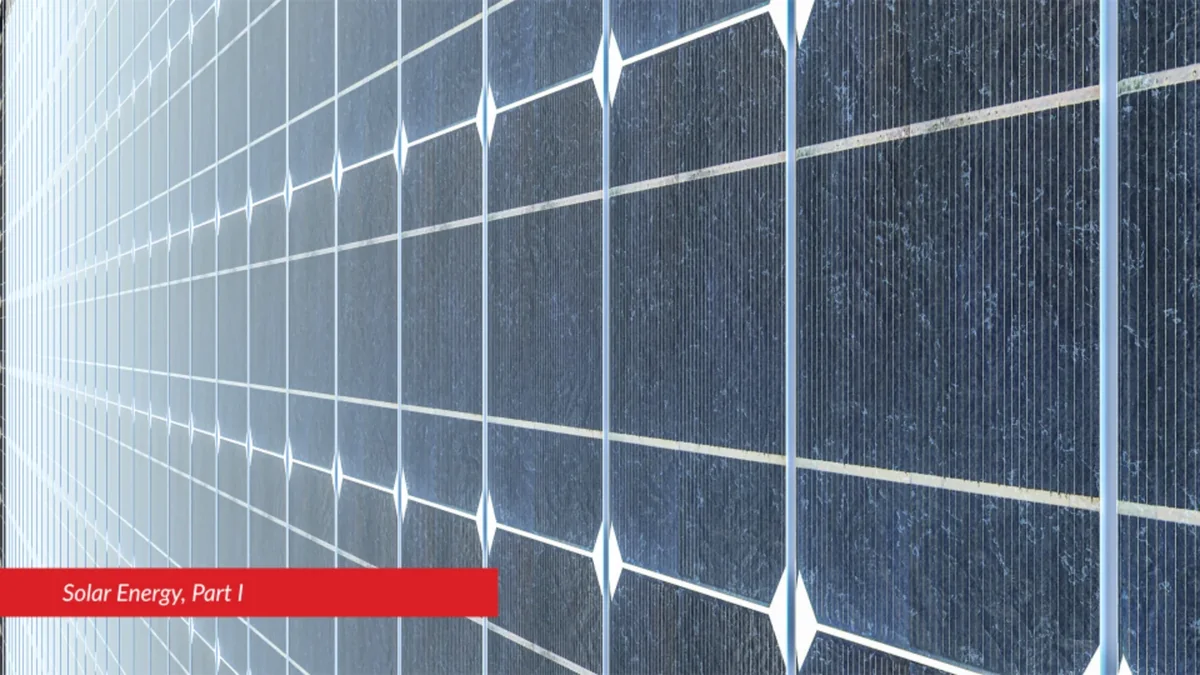
We’ve all been talking about solar like it’s a finished story. Installed capacity is climbing, costs have dropped, and deployment is global. By most external measures, solar looks like it could be a solved problem. But it isn’t.
Silicon photovoltaics have reached an extraordinary level of maturity. They’re reliable, bankable, and manufacturable at global scale. At the same time, they’re approaching a ceiling. Efficiency gains have slowed, manufacturing remains energy-intensive, and the performance required to fully displace legacy energy systems across geographies and use cases still isn’t there. We’ve built something that works, but not yet something that finishes the job.
That’s where we are now. The uncomfortable Act II. Progress is undeniable, but insufficient, and the system is beginning to strain against its own limits. It’s the point in the narrative when the hero stumbles, and it seems like failure is over the next horizon.
Act II is all drama.
Enter perovskites. They represent a fundamentally different approach to photovoltaic materials, with tunable bandgaps, lightweight thin-film structures, and tandem architectures that push efficiencies beyond what silicon can achieve alone. In the lab, their performance already rivals or exceeds conventional materials, and their projected manufacturing pathways suggest a fundamentally lower cost structure.
They make the next phase of solar believable. But frustratingly, they’re not ready to carry it.
The same properties that make them powerful also make them fragile. They degrade under light, heat, moisture, and mechanical stress. Their crystalline structure is highly efficient, but inherently unstable, with defects forming and interfaces breaking down in ways that are unacceptable outside controlled environments.
This is the tension of Act II. We can see what the future could look like. We can measure it, model it, and build working prototypes. But none of that guarantees reliability, and reliability is what we desperately need from energy systems.
That gap between demonstrated performance and dependable operation is where most technologies fail, and it is exactly where our hero is being tested.
About this piece.
Michael Trotter is Chief Executive Officer of Arradiance, LLC.
Continue with Part II: the problem isn’t the material, it’s the interface. For the published research behind perovskite interface engineering, browse the solar cell studies in the research library, or read the plain-English introduction to ALD. The ALD systems behind those studies are on the Systems page.