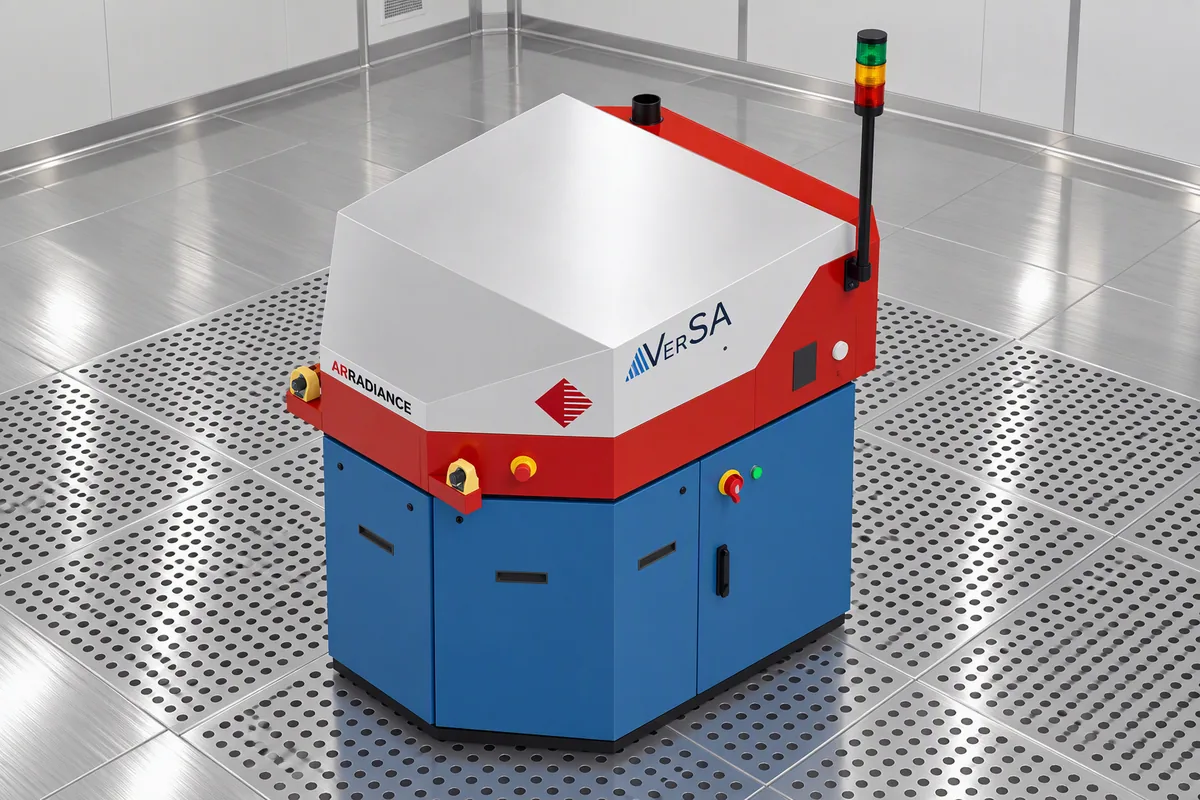
VerSA spatial ALD: ALD precision at the speed of traditional CVD/PECVD.
Traditional ALD delivers exceptional film quality, uniformity, and precision, but slow deposition rates have made commercial production costly and impractical. VerSA, the Arradiance spatial ALD commercial production platform, cuts deposition times from hours to minutes while keeping film properties comparable, on a platform designed for speeds up to 1,000 times faster than traditional ALD at its maximum rotation rate.
The film you need, at the throughput you need.
Until now, manufacturers have had to choose between the film properties they need and the throughput their operations demand. By reducing deposition times from hours to minutes while maintaining comparable film properties, VerSA removes a significant barrier to bringing ALD into commercial manufacturing. Faster deposition lowers production costs, increases throughput, and makes ALD practical for applications where conventional processing times have been prohibitive.
VerSA supports multiple chemistries on a single platform, so changing production requirements do not mean a separate system for every process. Arradiance works directly with customers to optimize those processes and configure the platform around their substrates, precursors, film requirements, and production goals.
Backed by our expertise.
| Film quality | Comparable ALD film properties, supported by measured uniformity and refractive-index data |
|---|---|
| Throughput | Spatial ALD deposition measured in minutes rather than hours |
| Flexibility | Multiple chemistries on a single platform, with process optimization and configurations tailored to your application |
| Partnership | Hands-on technical support as you move from research to commercial manufacturing |
Turning hours into minutes.
Comparative measurements across four metal oxide processes set spatial ALD against conventional temporal ALD on time to deposit a 100 nm film, non-uniformity, refractive index, and growth per cycle, so your engineers can weigh deposition speed alongside the film characteristics that matter. For the processes tested, spatial ALD cuts deposition time from hours to minutes while measured film properties remain comparable.
| Material | Process | Time to 100 nm | Speed-up* | Non-uniformity | Refractive index (n) | Growth per cycle (Å/cycle) |
|---|---|---|---|---|---|---|
| Al2O3 | Temporal thermal | 6.8 h | ≤0.45% | 1.66 | 1.1 | |
| Temporal plasma | 7.6 h | ≤0.89% | 1.68 | 1.2 | ||
| Spatial | 5.6 min | ≈73–81× | ≤1.1% | 1.64 | 1.5 | |
| SiO2 | Temporal thermal | 14.3 h | ≤1.3% | 1.46 | 0.08 | |
| Temporal plasma | 6.2 h | ≤2.3% | 1.46 | 0.15 | ||
| Spatial | 4.8 min | ≈78–179× | ≤2.0% | 1.44 | 1.72† | |
| TiO2 | Temporal thermal | 17.3 h | ≤1.9% | 2.54 | 0.40 | |
| Spatial | 14.6 min | ≈71× | ≤0.50% | 2.44 | 0.57 | |
| SnO2 | Temporal thermal | 5.3 h | ≤1.4% | 1.89 | 1.4 | |
| Spatial | 8.8 min | ≈36× | ≤1.1% | 2.02 | 0.95 |
* Speed ranges compare spatial ALD with temporal thermal and plasma ALD; ratios rounded.
† SiO2: the spatial process uses a different precursor from the temporal thermal process, with two silicon atoms per molecule, which accounts for most of the difference in growth per cycle.
These are results demonstrated today. At its maximum rotation rate, VerSA is designed for up to 1,000× the speed of temporal ALD; how much of that a process can use depends on what its film can tolerate.
Arradiance works with your team to translate these results into application-specific process conditions and system configurations.
Specifications.
System configurations are matched to each process. Download the handout for published results, or talk to a specialist about your substrate and throughput.
Set up a VerSA consultation.
Tell us your substrate, target material, and the volume you need to reach. A specialist will walk you through what VerSA can do for your process.
Request More Information